(Belated) February Update: Smash Mouth, Survival, & One Very Silly Goose

Photograph of Sir Gucifer Waddlesworth, an unpainted concrete porch goose wearing a dilophosaurus fin headband.

Smash Mouth really knew what they were going on about back in the 1990s: the years start coming and they don’t stop coming. Back then, I was still convinced that I was going to die young, somedays I still have no idea what to do since I didn’t. Here I am, twenty years older than I ever thought I’d be, living in one of those dystopian novels I’ve always hated. I’ve had more life experiences than I ever asked for, an old soul in a middle-aged body. Too old to be anyone’s manic pixie dream girl, but stuck with the ptsd and related wisdoms anyway.

Smash Mouth was right: it doesn’t make sense not to live for fun.

Don’t get me wrong, we need purpose too, but that’s always felt easier to find. There’s always a fight, which is just my privilege showing: there’s always been a fight. There always will be. I don’t feel old most days, but I could use some of my teenage anarchist energy now that the United States is worshipping at the feet of an orange-tinted Putin Puppet.

That said, surviving is about this biggest “fuck you” we can send to any regime, especially if (like me) you’re on the White House’s every-growing list of threats to the “American Way of Life.” I’m an anti-fascist, college-educated, liberal, queer, AuDHD, woman who refused to bear children so I’m on there at least six times that I know of. It’s been a rough month and a half but I think a lot about that C.S. Lewis quote from his 1948 essay “On Living in an Atomic Age” –

If we are all going to be destroyed by an atomic bomb, let that bomb when it comes find us doing sensible and human things praying, working, teaching, reading, listening to music, bathing the children, playing tennis, chatting to our friends over a pint and a game of darts—not huddled together like frightened sheep and thinking about bombs.

This is not to suggest inaction. I don’t think Lewis would have advocated it and I’m certainly not either. I know there are some differences between the threats we face daily and the constant nuclear terror that so many experienced during the Cold War (fewer differences now that we have the angry, spineless, would-be king back in DC). But I say all that to say: there is a great deal of very sound reason in doing what you can and then not letting the bastards get you down. It may feel dissonant to live as if dire things are not happening, but dire things have always been happening. What we can learn from our past, and from survivors among us, is that LIVING is the very essence of persistence, of resistance, of rebellion, of FIGHTING BACK.

Queer and neurodivergent joy are resistance. Creating art, literature, safe spaces for folks to gather, to teach and learn and LISTEN to each other: this is also resistance. Supporting your peers, loving each other, finding, boosting, and encouraging voices: all resistance. Coming together in community, feeding one another, speaking out together. There has always been great power in these and there still is. I hope you are able to find it, and if you can’t, I hope you’re able to make it.

For February, along with spamming my reps, I kept busy in the good, nurturing sorts of ways – reading, writing, and doing work over at Reckoning that I find important and meaningful and deeply rewarding. Work that we need more now than ever. I’ve also been reaching out to find community. This is difficult for me as I’m a solitary creature, much like a porcupine. It’s been good for me though. I have started meeting regularly (virtually) with a writing friend. In just a few weeks, I finally broke my two year writing slump. I started and finished drafting a whole (5.5k) short story! It has since been beta-ed, revised, and edited. I plan to start subbing it out tomorrow. \o/

In self-promotional news, my short story “A Predatory Transcience” (which was published by Reckoning in 2023) was recently featured on Episode 39 of Reckoning’s Podcast. Read by Bernie Jean Schiebeling and produced by Aaron Kling, if you’ve been waiting for audio, you’re in luck! You can listen on Reckoning’s website or Subscribe via RSSGoogle PodcastsAndroidStitcheriHeartRadioApple or Amazon. It’s about a half-hour listen.

And finally, please allow me to introduce Sir Gucifer Waddlesworth. The concrete porch goose my parents got me for Christmas has made it home! Soon, he will have emo bangs, devil horns, and a tuxedo (he will also be on our porch), but his first costume came in this month. Behold the Silly Goose Glory! (and me, equally silly, in my Dilophosaurus Dress. why yes, that collar is meant to mimic the fin/ruff on the Jurassic Park version of the dinosaur.

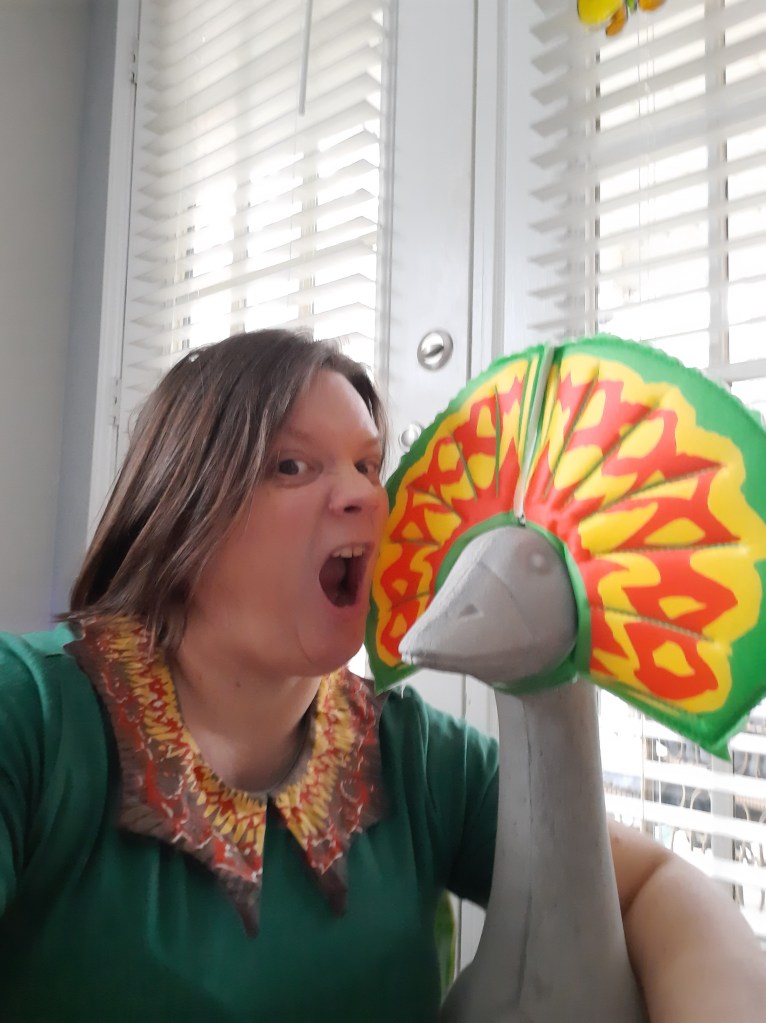
Selfie of me (a middle aged white woman with  a short auburn bob and dark eyes) and Gucifer. He is wearing his dilophosaurus fin and I am wearing my green dilophosaurus dress. I am facing forward and smiling.
Selfie of me (a middle aged white woman with  a short auburn bob and dark eyes) and Gucifer. He is wearing his dilophosaurus fin and I am wearing my green dilophosaurus dress. I am facing Gucifer with my mouth open as if to bite him.
Selfie of me (a middle aged white woman with  a short auburn bob and dark eyes) and Gucifer. He is wearing his dilophosaurus fin and I am wearing my green dilophosaurus dress. I am kissing Gucifer's cheek.

Social Media Pro-Tip: It’s Not Always About You (or me)

The timing of this post may not be perfect. It is not really about current events, of which there are too damn many, but rather about social media interactions in general. But those interactions are ramping up (because of current events) so I wanted to ramble a bit about my own experiences navigating social media as a socially inept (in my case autistic) person. (though social ineptness is not reserved for us, and should also not be confused with being evil, in case I’ve not yelled about that enough).

Something I’ve learned in the entirely too many years I’ve been on social media is: it’s not always about you (or me). That post that feels like it’s accusing you of being a bad parent or friend. That response post about a meme that you and thousands of others shared. That post about a group you belong to or support. That event that happened that you were also aware of. A post that just seems to be really close to a vague reply to something you posted a few days ago.

It has nothing to do with you. Take a breath. Close the computer.

There’s a trap in thinking that someone on social media knows you well enough to judge you. Especially if your only interactions are on an app that has been (time and again) found guilty of manipulating what you see. No matter how openly and honestly you post, your social media will only ever be part of you. And a narrow enough snapshot at that.

We bring too many assumptions to these apps. Some of us assume everyone knows the context of our posts, our thoughts. Some of us believe we’re informing everyone of importance by posting on social media. The number of times someone has said to me “well I posted on FB, didn’t you see it?” No, I didn’t. Too many of us need to spend less time in these spaces, not more. If it’s important, we should take the time to tell someone individually.

Now, this doesn’t mean you can’t post on social media. Social media acquaintances are valuable, and social media can help maintain other, deeper relationships. Just know that unless you are narrowly controlling your audience, you can’t always predict how your posts will be interpreted. And that’s okay.

An important part of social life that we forget is that we can’t be comfortable all the time. We’re going to disagree; most of the time* that’ll even be okay. We’re going to be misunderstood; most of the time we won’t be able to change that. We’re going to be wrong; we should do our best to learn and live better once we know that.

But we have to give each other** grace. And also remember that all the crap on the social media isn’t really about us. Ultimately, it’s about creating confusion and miscommunication and panic so we’ll run out and comfort buy something from our right side panel.

*it’s not okay to disagree about Nazis.
**we are not giving Nazis grace.

The Woman Called Witch

I struggled for years with how much and why I hated witches, especially when I don’t—in fact—hate those who call themselves witches. I am a feminist, a historian, a religious studies scholar. I’m a queer autistic woman in her forties. I don’t actually hate witches. I may dislike certain appropriative expressions of neo-pagan faiths for their inherent issues of racism and colonialism, but I do not hate the wild women, the woods-women, the wise-women or the wonderers.

I have dear friends who have reclaimed the word “witch,” and respect the faith and practices of others who—in myriad beautiful ways—claim that name for themselves. I admire the crones who have found their voices, and I like to think that I have long been one of them (though wisdom came more slowly than the strength of my voice).

I have been called “hearth witch” and “wood witch” and “swamp witch.” When I turned these over and examined them, they fit about as well as any other cloak I’ve worn—better in some ways—but I still didn’t call myself witch. I have never claimed any kind of magic, and even when given that compliment from others, I never understood why a part of me cringed. Then I realized:

I am the woman others call “witch.”

I am the woman who doesn’t quite fit. The one who doesn’t belong. The one who doesn’t mind that she doesn’t belong. The woman who isn’t pretty enough or womanly enough or straight enough, or interested in performing whatever feats she must to achieve those. I’m the woman at the edge of the village, the woman at the edge of the woods. Never quite a part of either. The woman who speaks too loudly and freely. The one who tells truths no one dares to say, and fewer want to hear. I am the woman who is too much for the village, who disrupts their everyday harmony, who is rarely invited in, but without whom they cannot exist. Not really. Not for long. Because the witches know things. Because when life seems impossible, the witches are the ones they come to. Because being unwanted is not the same as being unneeded.

I am the woman they call “witch.”

Once upon a time, a village lived and died by who it chose to silence. Some revered us, some tolerated us, some ignored us until a child was sick or a heart was broken or a cow refused to milk. They needed us then—as healer, as wisdom, as scapegoat—and they need us now. And yes, they feared and fear us too, women who are not enough and too damn much and filled with everyday magic. They forget now and then and they punish us for their own failings, their own fears. They watch us burn like earthbound stars, condemning themselves to worse than our absence.

(But no matter how poetic, our deaths are not justice).

I am the woman they call “witch.”

I talk to animals and sing to trees and believe that we find the Divine in the wonders of our world and the stars above us. Sometimes even in each other. I call birds friends and I feed the hungry wolves when they show up at my door. I have ridden wild ponies without intent or control, without the need to assert my own spirit over theirs. I have swam with sharks and rays without trapping or baiting. I have rehabilitated deer, and I eat venison with full awareness and thanksgiving for the life that nourishes mine. I can heal and crush hearts with a handful of words. I can tell you what spices are medicinal and tasty. I make a mean pot of tea. I would prefer a cottage deep in the woods, but I live on the edge—that murky, misty green border—because I believe it is here that I can do the most good for others.

I am the woman they call “witch.”

This was never my never. I am a mender, a tender, a gardener. Scholar. Memory Keeper. I am a welcome hearth and a cup of tea and somehow I always feel like autumn. I am a word-tangler and worlds-wanderer and I prefer the company of hellhounds and songbirds and the beautiful, (and perhaps foolish) soul who returns daily to edge of the woods for nothing more or less than who I am, no more or less mine than the creatures who always seem to find me.

Witch was never my word, but it has grown on me. Like moss and magic and unexplained mysteries.

I am the woman we call “witch.”